Fundamentals of Musical Composition
2026-11-24 — music
I have been studying the music theory book "Fundamentals of Musical Composition" by Arnold Schoenberg and I want to write about how and why I'm doing this.
About Schoenberg and "Fundamentals of Musical Composition"
Arnold Schoenberg (1874-1951) was a composer and teacher. He was born in Austria and moved to the United States in 1933, where he started to teach at USC and UCLA in Los Angeles. Fundamentals of Musical Composition was published posthumously in 1967, edited by his teaching assistant Gerald Strang.
Feelings about music theory
I dislike music theory for two reasons. First of all, music is something I want to feel, and putting on my rational, verbal thinking hat gets in the way of feeling things.
Second of all, logical analysis reveals patterns, and for some reason patterns become rules. For example, once I learned that a particular song I liked uses a minor pentatonic scale, for months I was only improvising minor pentatonic melodies. It felt like I was trapped.
Having said this, I want to get better at making (composing) music and I believe it is essential to get better at hearing what is going. Learning music theory is a tool to learn to hear more. Just listening to a lot of music is not enough, for me.
How did I end up with this book
A while ago I saw a reference to "Harmonielehre", Schoenberg's first music theory textbook, somewhere online and I decided to have a look at it. I found the book difficult to read because of Schoenberg's endless philosophical digressions but what stuck with me was how much he hated music theory himself. Precisely because theorists start considering the patterns they observe to be laws. I could relate to how he felt. But the book was too dry for me to work through so I put it aside.
Some time later I came across a reference to Fundamentals of Musical Composition and I decided to look at it too. It is written in a very different style from Harmonielehre: it's very terse, almost like a mathematics textbook. At the same time, it is less abstract. In Harmonielehre, most illustrations are block chords in piano notation. A succession of two chords does not feel like music: it is just telling you what to play on the piano to hear the sound he talks about. In Fundamentals of Musical Composition on the other hand, the examples are short bits of sheet music of real music. These are not abstract but concrete examples.
I liked the terse style and the abundance of real examples, and of the few sentences I understood, I agreed with what he said. So now I am reading Fundamentals.
Reading this book goes slooooow
I would estimate I am able to read this book at a pace of 1 page per day. In order to understand what Schoenberg is saying I take notes, and I try to listen to every example of music he mentions.
"Literature" music examples
When Schoenberg talks about "examples from literature" he means real published music. For most of these there are bits of sheet music in the book. I make Spotify playlists for myself of all his examples so that if he says "Example 45 (a)" I can open the "Example 45" playlist and click the first track. If the score is not in the book I go to IMSLP to find a public domain score of the piece in question.
This sounds simple but it's quite a lot of work. Classical music is typically catalogued and numbered but there often are multiple, conflicting numbering systems for the same composer. For example Haydn has opus numbers and Hoboken numbers, and Schubert has opus numbers and Deutsch numbers. Schoenberg is not always clear about what numbering system he is using. Sometimes the numbering that is dominant today, like the "BWV" catalogue for Bach, did not even exist when Schoenberg wrote his book. In these cases I have to compare the sheet music printed in the book with other sources to figure out what piece he means.
There are also issues like compositions that have multiple sections but that get published as a single track on a CD, and then I have to find out where the section is by reading the score of the larger piece, and remembering a timestamp in a CD track. For example the Scherzo of Beethoven String Trio opus 8 is mixed into "part III" where it alternates with the Adagio. To hear the Scherzo, I need to seek to 1:33 in the recording I'm using.
I do a lot of detective work just to get quick access to all the examples. And this is necessary because in some chapters he refers to 50 different compositions to illustrate his points.
Examples written for the book
Other examples are simple illustrations of musical ideas, that Schoenberg wrote for the book. Something like "these are all the ways you can arrange the notes in a broken chord" or "here is a theme, this is what happens if you change the notes but not the rhythm". Some of these examples I can sight-play on the piano but others are too difficult for me.
Here I came up with the solution of converting the scores in the book into GarageBand MIDI projects played back on a virtual piano. This way I don't have to worry about playing correctly and I can focus on how the music sounds.
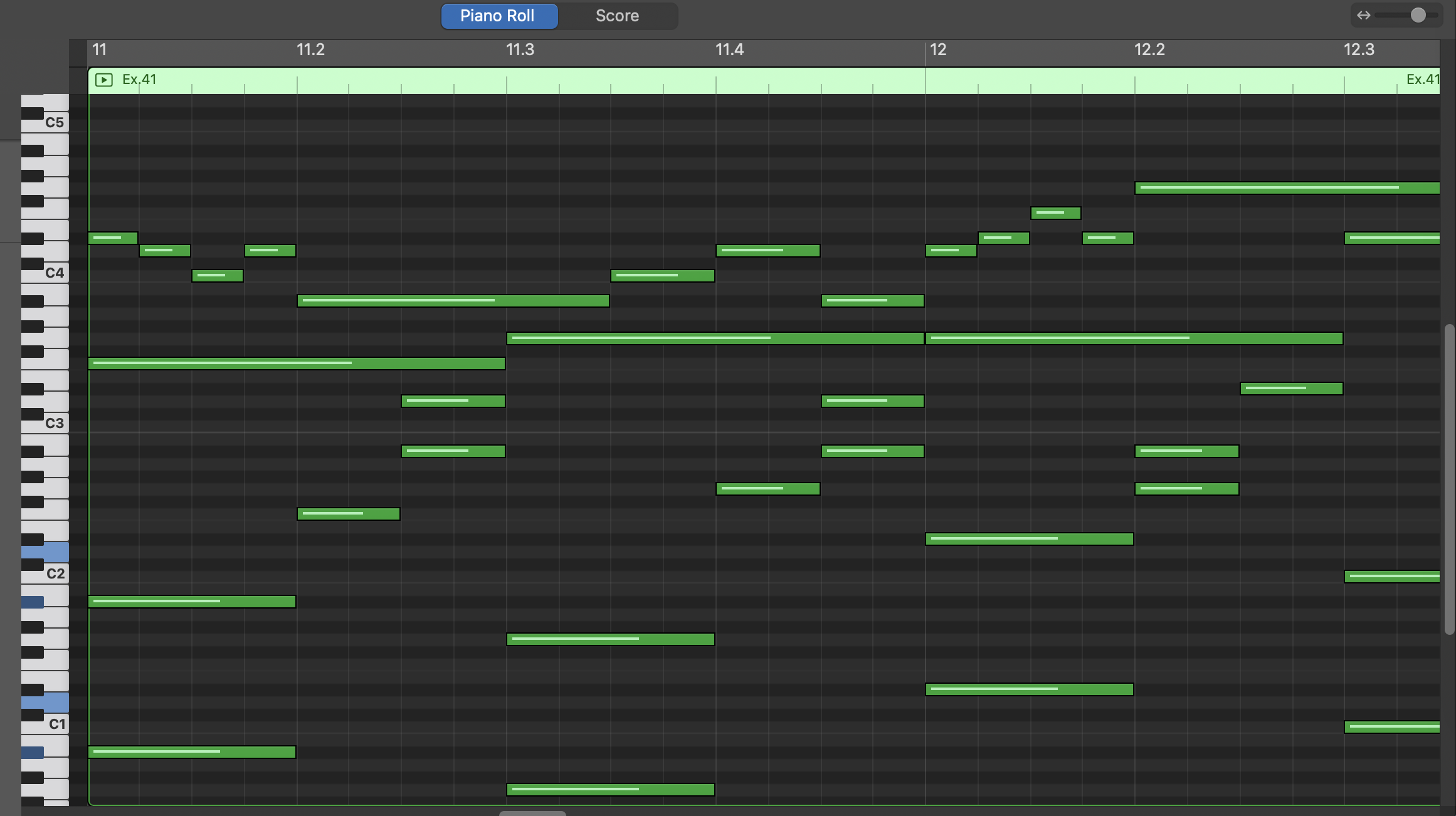 Part of Schoenberg's Example 41, converted into GarageBand MIDI data.
Clicking scores into the piano roll grid of GarageBand is dull but there aren't too many of them.
It took me quite a while just to come up with these two solutions: Spotify playlists and GarageBand projects. Before that I kept trying to play stuff on the piano, or looking up music on Spotify ad hoc. It's better to do the up-front work of making the playlists and entering the MIDI data.
Taking notes
Besides listening to every example he mentions, to see if I can hear what he is talking about, I also take notes. I use a text file on the computer for note keeping. My current system is to copy one sentence of the book into my text file, something like:
When the coherence between the basic motive-forms and the more remote derivatives in m. 3-4 is not quite obvious, a connective may bridge the gap. One of the features, often the upbeat or a preceding motive-form, is used to join them. (Exs. 44d, l, 45c, d, g, 46e, 47d).
Then I write my own thoughts and notes underneath.
What the hell is a "feature". I think "upbeat" means pickup. Ex. 44 (d) the two 8ths pickup is part of the motive, which are used in a different direction but they make the flow into m.3 more natural. (l) the last 16th of m.2 is a pickup leading us into m.3. Ex.45 (c) yes he reuses the pickup of m.1 and m.2 for m.3, two quarter notes.
And so on for all 7 examples he mentioned in that one sentence.
If I don't do this, I find that what Schoenberg says doesn't really stick. In this book he does not repeat himself so I need to make sure I catch everything he says.
What am I learning
It is perhaps surprising that I am now learning how Beethoven Piano Sonatas and Haydn String Quartets are put together, considering that I make Detroit techno-inspired dub music. However, (1) I think some principles apply to most (all?) music regardless of genre, and (2) I don't care if reading this book is "useful" or not because I enjoy it.
Conclusion
I don't know yet what the conclusion is. I am learning how to read this book, which is a lot of work. I am learning to listen to music better. Where does it lead?
More about: music